|
|
|
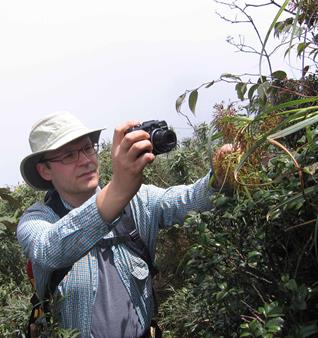
Mount Phan Xi Păng, Vietnam, 2015.
Photographing
Sumatroscirpus rupestris Lév.-Bourret & J.R.Starr,
a new species and the first time the genus was recorded outside of Sumatra
over 2,400 km away (see PhD research of Étienne
Léveillé-Bourret below).
|
Dr. Julian R. Starr
Professor,
University of Ottawa
(Office: 286 Gendron)
Mailing
Address:
Biology
Department, University of Ottawa, 30 Marie Curie, Ottawa, Ontario, Canada,
K1N 6N5. (Directions
to office)
Tel: (613) 562-5800 ext. 6100
Fax: (613) 562-5486
E-mail: jstarr@uottawa.ca
Laboratory:
Centre
for Advanced Research in Environmental Genomics (CAREG)
CAREG 313, 20 Marie-Curie
Tel:
(613) 562-5800 ext. 2068
|
Research Interests:
My research is focused on Systematics,
the science that names, classifies and determines the evolutionary
relationships of organisms. The basic goals of systematics are to discover
biodiversity and to arrange it into predictive phylogenetic classifications
(think genealogical). These classifications provide a comparative framework
for testing evolutionary, biogeographic, and ecological hypotheses and they
are the basis upon which informed conservation decisions are made. In other
words, the importance of systematics is that it provides the units (species,
families, etc.) and the means (classification, phylogeny) to make valid
comparisons in biology. To resolve such diverse subjects, our laboratory uses
both traditional methods like anatomy and morphology in addition to modern
molecular techniques (e.g., DNA Sanger and Next Generation Sequencing,
microsatellites, fragment analyses, etc.).
Family
Cyperaceae:
Although I work on all types of
vascular plants, and occasionally algae and insects, my primary focus is on
species from the sedge family (Cyperaceae), a truly remarkable group
characterized by its exceptional diversity (ca. 5,500 species), varied
habitats (deserts to rain forests), unusual cytology (2n = 12 to 112) and
diverse biogeographical patterns (e.g., Gondwanan, bipolar). My long-term
objectives in this family are: (1) to discover the evolutionary relationships
of Cyperaceae clades; (2) to reveal historical patterns of character
evolution and phytogeography within sedges; and (3) to produce predictive
classifications that can be used by scientists, conservationists and the
general public alike.
Some Current Projects:
(All these projects offer numerous
opportunities for graduate and postdoctoral work)
(1) Systematics of Cyperaceae: I
started my career focused on Carex and its tribe Cariceae, two taxa
that are so morphologically peculiar that their nearest relatives have been
the subject of speculation for over 100 years. One day in the field in
California in 2006, I saw Eriophorum criniger (A. Gray) Beetle (=Scirpus
criniger A. Gray) and I was immediately convinced not only that it was
not an Eriophorum or a Scirpus, but it could even be a new
genus and maybe the sister to Carex.
My former M.Sc. student Claire Gilmour took on the
initial challenge naming not only a new genus, Calliscirpus C.N.
Gilmour, J.R. Starr & Naczi, but even a new species, C.
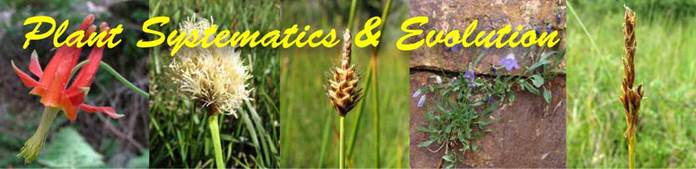
brachythrix. The second plant on the top left of my webpage is the
new species, and from the picture you can see the genus is among the most
beautiful and striking to be segregated from Scirpus (the Greek prefix
Calli- means ‘beautiful’). Étienne
Léveillé-Bourret then arrived to continue this research for a
PhD in 2013 by looking at the entire clade that contains Calliscirpus,
tribe Cariceae and their relatives, which includes the genus Khaosokia,
and various genera in tribes Scirpeae and Dulichieae. In a series of six
papers (see Publications),
he discovered four new tribes including the first new Cyperaceae tribe
in 29 years (Sumatroscirpeae), a new genus (Rhodoscirpus,
named for Rosa Guaglianone, the Greek prefix Rhodo- means
‘rose-like’) and a new species, Sumatroscirpus rupestris.
Moreover, his studies highlighted the extraordinary conservation
importance of tribes Khaosokieae (~46 MY old lineage, 1 sp.), Calliscirpeae
(~41 MY old, 2 spp.) and Sumatroscirpeae (~36 MY old, 4 spp.), and
stunningly, he determined that Sumatroscirpus, which was once thought
to be monotypic and endemic to Sumatra, was in fact a genus consisting of 4
extremely rare species, two of which were found >2400 km away in
Vietnam, Myanmar and China. However, his most amazing discovery was that Sumatroscirpus
was sister to Carex, a cosmopolitan genus with more species than 92%
of all plant families. All future phylogenetic or evolutionary studies on Carex
should now use Sumatroscirpus to root trees and infer evolutionary
change. He has done so much that I am now turning to completely new lineages.
(2) Phylogeny and evolution of Carex
and tribe Cariceae: This is ongoing research that I
have been working on since my very first publication as first author in 1999
(Starr et al. 1999).
In 2009, I published a review on the subject with Bruce Ford in The
Botanical Review (Starr & Ford 2009)
where we highlighted the poor representation of Asian taxa in former
phylogenies despite their often peculiar morphology and their key
phylogenetic position as sister to several major lineages in Cariceae. This
led us to apply for two National Geographic Research Grants to travel
to Vietnam in 2012 & 2015 where we were able to collect many key
taxa for understanding the evolution of Carex. With our Vietnamese
colleagues, Nguyen Thi Kim Thanh (Hanoi University of Science) and Vũ
Anh Tài (Botany Vietnam Group), and with the help of Jack Regalado
(formerly of the Missouri Botanical Garden) we were able to rediscover many
morphologically unusual species that had not been collected for more than 70
years. In fact, several species were only known from their holotype or just a
handful of collections. As you might expect, the results of this research
have been stunning. We have discovered three new early diverging lineages
in Carex (Starr et al. 2015;
the "Hypolytroides Clade", the "Dissitiflora Lineage" and
the "Small Core Carex Clade"), multiple new Carex species
(Ford et al. 2017),
and on one of these trips, Étienne discovered Sumatroscirpus
rupestris (see above), the species and sample that would conclusively
demonstrate that Sumatroscirpus was sister to Carex.
This supported the long-held hypothesis that Vietnam and Southeast Asia could
be a possible “cradle” for the genus Carex. Hopefully in
2024, we will be going back to Vietnam to further study these peculiar Carex
and to better understand the morphology, ecology and cytology of Sumatroscirpus.
One can only dream about what we may find this time! Do you want to come
along?
(3) Biogeography of sedges: Léon Croizat (1952) once said
that you could teach an entire course on phytogeography using only examples
from Carex and its allies in tribe Cariceae. There are sedge species
and groups with almost every imaginable biogeographic pattern (e.g.,
amphiatlantic, Gondwanan, bipolar). What forces created such extraordinary
distributions? Several of my former students have worked on the systematics
and phylogeography of two extraordinary arctic-alpine groups Carex nardina
(Wayne Sawtell) and Carex capitata (Tamara Villaverde
Hidalgo), but there many more wonderful groups to study. So far we have
travelled from the arctic to Tierra del Fuego on these projects and who knows
where next. These are collaborations that I am conducting with my colleagues
Modesto Luceño (Pablo de Olavide University, Sevilla) and Leo
Bruederle (University of Colorado, Denver), amongst others (see Publications).
(4) Sedge DNA Barcoding: So
far we have completed two research projects, a preliminary study to determine
which of the proposed chloroplast barcoding loci would be best for sedges
(Starr et al. 2009; PDF
on Publications Page) and a paper in Molecular Ecology
Resources that demonstrates 100% species resolution when a regional
approach to DNA barcoding is taken for the sedges of the Canadian Arctic
Archipelago (project led by former Honour’s student Jessica
LeClerc-Blain; LeClerc-Blain et al. 2010).
The most ambitious project of them all, the goal of barcoding all 483 species
of Carex and Kobresia recognised in the Flora of North America,
North of Mexico, has not been published (project led by my former graduate
student Brianna Chouinard in collaboration with Robert Naczi at the New York
Botanical Garden), but it generated enormous amounts of data that we continue
to use and publish (e.g., Jiménez-Mejías et al.
2016; ~1500 matK sequences or three for nearly
all North American Carex). I am currently searching for students that
would be interested in working on some of the taxonomic problems that were
highlighted by her research. Would you like to name a new species?
And many
others…
(If you are
interested in learning more, please contact me)
|